
Yelena deciphers Yaponchik's cryptic riddle pointing to Fukuyama's hideout deep in Aokigahara—Japan's infamous suicide forest. A chance encounter with a corpse scavenger provides the key to finding the remote location, but extracting information requires persuasion of the brutal kind. Following an overgrown trail marked by supernatural warnings, she finally arrives at her destination: a decaying ryokan known as the House of a Thousand Eyes.
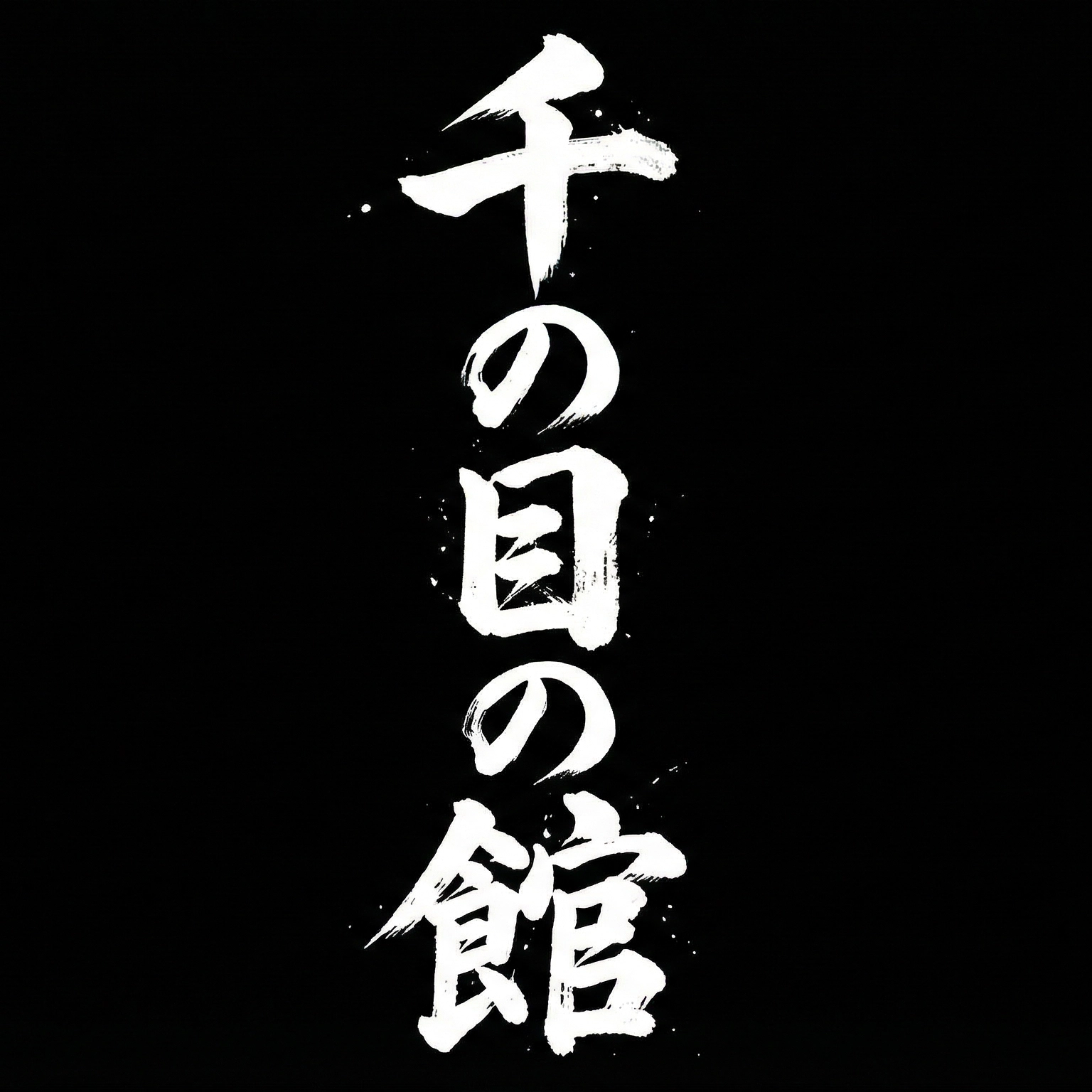
House of a Thousand Eyes
Life is a precious thing given to us by our parents. One more time, let's calmly think.
Hello, moon.
I see you bathed in red, catching glances at your fat round face rising in the rearview mirror behind a mountainous silhouette dominating the horizon. The serene moment is framed within the glass of the back window. Peaceful, some might call it, but there is no peace inside me, no serenity felt when my eyes trade the road for the mountainscape in the mirror.
There is only the anticipation of the reckoning to come.
Yaponchik’s drug-induced confession was the poetry of a broken mind. Every time I pressed for Fukuyama’s location, the answer returned as the same loop of metaphor, the rhythm severed only by the lazy, heavy blinks of her blown, glassy eyes.
“Nemureru Kyojin no fumoto…
himei o nomikomu mori no agito…
soko ni, sen no me no yakata ga aru…
soshite Fukuyama wa…
shisha to tomo ni cha o nonde iru.”
Go to the foot of the Sleeping Giant…
in the mouth of the forest that swallows screams…
there you will find a House of a Thousand Eyes…
and in it, Fukuyama…
drinking tea with the dead.
A riddle. Not difficult to crack. Fuji is the dormant volcano in the heart of Honshu and the forest is Aokigahara, an ocean of lush green and towering timber rooted in the nutrient-rich soil of the mountain's ancient lava field. And the swallowed screams? Those belong to the desperate and the weary lured to the jukai in search of serenity. Some find it at the end of a rope, others at the bottom of a bottle. According to myth, their spirits become yūrei, ghosts cursed to roam the physical world.
As for the House of a Thousand Eyes, I am at a loss. Aokigahara is a labyrinth of trails that criss-cross thirty square kilometers, where compasses and GPS chips are rendered useless by the high concentration of iron in the soil. Fukuyama’s hideout will not be near a tourist trail where anyone could stumble upon it. The house will be hidden deep in the wildwood, at a place known to only those with intimate knowledge of the forest.
So how do I find one shack in the middle of a sea of trees?
Tactically, I’m flying blind. Anyone living in the wilderness will require food, clean water, and sanitation, but Fukuyama is smart. And disciplined. This was not a decision made lightly. He came prepared to live off the grid long-term. He would have brought non-perishable foods like dried rice and canned goods, chosen a location near a natural source of fresh water or with a well on the property. As for sanitation, there are no sewers in this area. That means a septic tank which requires regular maintenance. Paperwork. Witnesses. No, he’s not that stupid. He’d sooner use a latrine—or a slop bucket.
Ahead the trees open into an intersection drenched in moonlight. Green turns red. I ease onto the brake, bringing the Mercedes AMG G63 to a gentle stop next to a triangle-framed storefront beneath a blue sign that translates to Wind Cave Shop.
Beams of light spill over the intersection as a vehicle lurches from the adjacent lane. The silence breaks with a sharp bang, a backfire that cracks the air like a gunshot, then the engine dies, leaving the snub-nosed Subaru Sambar to coast through the intersection, drifting helplessly into my path. Headlamps wash across the pickup’s beat-up, rusted side panels before spilling through the glass to reveal the driver. Rat-faced. Frantic. One hand beats on the wheel, the other fights with the stick shift. Light crawls over his screaming features—the buckled pockmarks, the patchwork of mangy facial hair, a mouth full of black gums and shattered teeth. Gross.
His clothes tell an interesting story. I recognize the Arc’teryx parka—the kind serious mountaineers wear—but it's two sizes too big and stained with engine oil and forest muck. Then there’s the scarf tied beneath his mangy goatee. Cashmere. Much too delicate for his rough neck. I think to myself, here’s a fella wearing someone else’s clothes and I wonder, what sort of person gives away a thousand dollar down jacket?
The transmission finally grinds into gear and he reaches for the key. The engine sputters back to life. A burst of black smoke spews from the tailpipe with another loud pop and the pickup lurches forward. It doesn’t turn—it rumbles forward, leaving the road for the pavement outside the shop. It parks next to the building, beneath the eaves.
I hit the turn signal.
The light turns green and my foot feeds fuel to the engine. The wheel turns between my hands and the Mercedes glides left through the crossing, pulling in behind the Sambar as the man skulks towards the entrance. His posture jerks with the nervous energy of a meth addict, rubbing his hands together in excitement, plodding inside in a $300 pair of La Sportiva alpine boots large enough to go with the person that jacket belongs to.
I park, kill the engine and get out.
Before heading inside, I join the halves of my aviator jacket together and zip it closed. The bottom tightens around my waist—and around the yoroi-doshi dagger buckled horizontally across my lower back. Then I shut the Mercedes’ door and start walking, every step of my Renegade Evo cold weather trailbeaters crunching over concrete and loose gravel. As I round the corner, I tug the collar up against my braids then approach the door. They open with an electric whoosh.
“What did you find this time?” a voice asks in Japanese as I step from concrete to bamboo. A gentle bell rings, announcing my presence. It came from the register, where Mr. Skulker and the clerk are laughing back and forth. When they hear the ding, their heads turn to see me.
The skulker reacts first. Unable to contain himself, his rotten mouth peels open to throw an insult at me.
“Kono dekee ama ga!”
(That is a huge bitch!)
The clerk extends his fat arm over the counter to smack his friend on the shoulder. Mr. Skulker holds his arm like it was broken and lodged a brief, quiet formal complaint in the form of an elongated Nee~!
The clerk, a twenty-something man-child with a bowl cut, waved at me and smiled behind thick round glasses.
He says, “Aa, konnichiwa! Mori no eki kazaana e irasshaimase!”
("Oh, hello! Welcome to Wind Cave Shop.")
I raise my gloved hand and give a little wave.
“Kon-nee-chee-wa!”
I butchered the intonation. Japanese is a flat, rhythmic language. Westerners tend to put stress on the wrong syllables. Usually the third one.
Mr. Skulker laughs, believing he’s home free.
"Very good," the clerk says, clapping his hands together. His English is passable. "Please, look around! Maybe buy a bear bell?" He mimics ringing a bell near his ear. "Ring-ring! Keeps the scary animals away!"
I made a big face, a mock admiration of how well he speaks mixed with a touch of flirt. “You speak English very well. Thank you. I will do so, sir.”
A giggle escapes his lips. His face immediately slackens in shame and his hand rockets up his body to clamp across his mouth to prevent further embarrassment. I give one final wiggle of the fingers then turn to walk down the short aisle. My fake-fake smile melts into cold, still detachment. My brain assigns real time audio processing as Priority-1. Ears sharpen as I walk the aisle, pretending to be interested in the candy and confections displayed around an island.
The conversation plays out in slangy Kōshū-ben, a rough, rural cadence, often looked down on by city folk. Sound familiar? These are the Japanese version of country bumpkins.
“So, what did you find this time?” the clerk asks.
“Shit, let me show you,” Mr. Skulker says as his hand dives inside his jacket.
He produces a heavy object like a magician, complete with a dramatic ah-ha!
I feign interest in a box of overpriced chocolate truffles, giving me a brief opportunity to observe the two men. The object Mr. Skulker is holding like a dead fish is a watch—specifically a Patek Philippe Nautilus in rose gold. Depending on the finer details, that watch is worth at least a hundred grand in freedom dollars.
The clerk pokes at the watch, suddenly half-interested. He mews, “Oh, a watch. Okay.”
Mr. Skulker yanks it back with a grunt of anger. “You are an idiot,” he says, jabbing his finger in the air. “This watch is very expensive!”
The clerk straightens his back, his eyes distorted in the lenses.
“How expensive?”
“Fifteen,” Skulker says, then looks around before leaning in to finish, “million.”
Yen. Accurate.
“What?” the clerk asks. “Who had it?” His curiosity reignited, he swiftly reaches again for the watch, more eager to examine it now that he knows the value. The attempt is thwarted with a smack to the back of the hand.
The clerk takes back his hand with a yelp. “Nee~!”
Mr. Skulker snorts, “That’s what you get. Anyway, I found this business man hanging from tree. The suit looked expensive. Italian, maybe. He was fresh, too.” He laughs, a wet hacking squeal. “Wrist still warm. Didn’t even have to unclasp it. Just slipped right off.”
Hundreds of bodies are discovered in Aokigahara each year by hikers. Who knows how many of the soon-to-be deceased venture deeper into the thicket, never to be located, never to be returned home to their family. This man is a scavenger. An opportunistic fucker with a strong stomach and no shame to stop him from raiding rotting corpses for trinkets.
Things are coming up Gorgo.
I grab a box of chocolates in the shapes of little mountains and walk to the front. Mr. Skulker moves aside, grinning at me like a jack-o-lantern carved by a toddler. “Excuse me,” I say, bright and bubbly, then turn to face the clerk and place the chocolates on the counter.
The clerk scans the box.
“Rokusen ni-hyaku san-juu ichi-en.”
I feign confusion as I produce a roll of bills. He points rudely at the display. ¥6,231 stares back at me in blocky grid letters. “Ah!” I say while taking out a roll of cash from my pocket. I remove the rubber band and begin thumbing through the faces. Mr. Skulker licks his crusted lips watching me count out sixty five hundred yen on the counter.
I snap the rubber band back around the roll and pocket it.
“There you go,” I say and scoop up the box. “Yo-ee ee-chee-nee-chee oh!” I start walking for the door. The clerk asks about the change in Japanese. I shout back, “I’ll let you know how they taste.”
The doors swoosh open and the December chill takes me back. I stop and think, drumming the box against my leg as I plot my next move. Three options come to me, none of them ideal.
Option 1: Grab him before he gets in his truck and beat him until he gives me something useful. Downside: Very visible. If a car drives past, they will see everything, not to mention the clerk who might take advantage of the quiet to take out the trash. Also, I’d have to drag Mr. Skulker deep into the woods to prevent anyone stumbling across his body. What, did you think I’d let him go? As if.
Option 2: Grab him, same as before, but subdue him. Put him in the back of my car and drive until I find some quiet pull off where we can chat alone—then I beat him until he gives me something useful. Downside: His truck is still here. Depending on how close these two idiots are, the clerk might get concerned enough to call the police or a mutual friend. Doubtful but not worth the risk.
Option 3: I follow his truck, wait for the right moment, then make my move. Run him off the road if I have to. Downside: Damage my own vehicle. I can’t get stuck out here. I also can’t predict where he is going to drive. It’s possible I won’t have a better opportunity to question him than to do it right here, right now.
Behind me, I hear Mr. Skulker’s voice, muffled but growing louder. He’s coming.
I make my decision. Lucky number three.
The doors open. The bell chimes. Skulker comes shuffling in his too-big boots, his sleeve hiked up his arm to reveal the watch that was now clasped around his wrist. “So pretty,” he says in Japanese, then cackles like an old woman as he tugs his jacket back down over the face. At his pickup, he pulls the door open but doesn’t get in. He sees me in my car with the box of chocolates in my lap and four truffles packed in my cheeks like I’m hoarding them for winter. Our eyes lock between panes of glass. Slowly my hand raises into view and I give a single wave. He laughs, but it’s awkward, like he’s communicating with an alien, but he returns the wave before ducking his head to get into his vehicle.
The door shuts and the starter turns. After a few cranks, the motor sputters alive. He does a better job navigating the gearbox, getting it into reverse. The bucket of rust putters backward, curling behind my Mercedes before rumbling forward to turn onto the road.
I start the Mercedes and hit reverse. It rips backward in an arc, then stops. Before taking off after Skulker, I roll down the window and spit. A gooey wad of melted chocolate splatters across the concrete as the 4x4 roars into the empty intersection and whips into the lane.
I can still see the taillights. I gun it, pushing the pedal to the floor. All four tires spin for a breath before the tread catches asphalt, then the turbo V8 takes over, launching the Mercedes 4x4 down the highway at speed. With one hand steady on the steering wheel, the other finds a napkin in the center console, then I hum to myself in the mirror while cleaning my chin.
It doesn’t take long to catch him. I let off the gas, slowing to match his speed with a few car-lengths separating us. The highway narrows to two lanes carved through the encroaching forest, turning a country drive into a midnight canyon run between towering evergreens. We continue like this for a time, never passing another car and him seemingly none-the-wiser of the danger in pursuit. About twenty minutes have passed when his brakelights flash steady, and his truck slows before jerking right down a dark road. I don’t stop. Not yet. I continue until I’m sure he can’t see my lights cutting through the brush, then I do a u-turn in the middle of the highway.
My truck slows in front of the turn-off, a gravel road that disappears into void black where the moonlight no longer penetrates the canopy. There’s no sign of Mr. Skulker’s taillights but there is a sign next to the road.
青木ヶ原衛生センター
AOKIGAHARA SANITATION CENTER
Isn’t that something.
I feed fuel to the V8 and guide the 4x4 from pavement to frozen dirt and gravel. I kill the headlights, leaving only the weaker daytime running bulbs to cast a softer, closer glow ahead. Eyes stay peeled, tracking back and forth through the trees for any trace of the rat-faced scavenger as the road curves like a talon into the thicket. I see it then, brief flashes of yellow light between tree trunks. Ahead, the service road straightens and for the first time I see shape in the darkness. A chainlink gate, a dirt parking lot and a couple concrete buildings sit beneath a high-mast light pole. His truck is there, too, parked in the breezeway of the largest structure, the one with the stack pumping black smoke into the sky.
I stop the 4x4, kill the engine and pull the key, dousing my daytime lights. Then I wait, hidden in the dark, to see what he’s up to. I don’t have to wait long. He comes out shortly after to fetch a garbage bag from the truck bed, then disappears back inside.
The door shuts behind me and I move quickly, boots taking the path next to the road, where gravel gives way to solid dirt. I pass through the shoddy gate he was kind enough to leave open, steps hurrying now, making short work of the fifty meters to the side of the building. I press my back against the side of the breezeway just as I hear him return with a snort, then a spit, followed by the rustle of another garbage bag. As he fights with it, I slowly lower the zipper of my jacket to uncover the black cashmere turtleneck worn underneath.
I wait for the noise to drift away before I lean around the corner. An open door leads down an industrial corridor. I don’t hurry anymore. I walk with purpose around the truck and into the hallway. The walls are corrugated steel with pipework. It’s hot inside, and humid. Condensation drips onto rusted grates beneath fluorescent bulbs encased in dirty plastic houses. Every few meters, I come across a door. One is an office. Another looks like a breakroom with lockers and a kitchenette. I noticed the smell of something burning when I first entered, but now it’s overpowering. Ahead, a sign reads INCINERATOR in Japanese above an open door.
My hand moves behind my back. Fingers curve around the handle of the yoroi-doshi and I take slow, soft steps into bone dry heat, like a sauna cranked to the max.
I find him kneeling over an open trashbag, picking through the contents. Wallets are plundered for cash. Jewelry is examined for the right amount of sparkle. He cackles while eyeing a wedding band before placing it in a pile next to his leg where most of the valuables go. The rejected treasure gets tossed into the fire-filled gullet of the steel furnace. His process isn’t foolproof. That Montblanc pen that just went head over heels into the coals could have paid for a brand new pickup.
He picks up a silver zippo and strikes the flame. His eyes watch the dancing flame as he turns on the ground, shifting weight to his other knee. “Pretty flame,” he says with a goofy grin before snapping the lid shut.
And there I am, the monster in the dark.
In the firelight, I say slowly, "Konnichiwa..."
He screams like a girl and leaps to his feet. His eyes dart around the room, then he lunges in an attempt to slip past. I leave the dagger in its sheath, seize him with both hands, then swing him around until his chest slams into the wall. I have his right arm wrenched and bent backward. I can already hear the tension in his shoulder. Ligaments stretching like rubber bands.
“Take it all,” he yells, referring to the tokens of the dead. “I will never speak of this. I swear!”
“Shut up,” I say, turning my attention to his sleeve. I drag it up his arm, revealing the watch.
“What, did it belong to someone you know?” he asks as I unclasp the band and stow it into my pocket. “No,” I answer, then twist his arm with a crack. He screams again, but this time it’s a pathetic whine, like a rabbit caught in a snare.
“Ahh!” he cries. “Then what do you want, you crazy bitch!”
I push the arm upward. His throat croaks, then I hear the sound of piss dribbling inside his pants.
“I’m looking for someone,” I explain.
“Who?”
“A man named Fukuyama.”
His one eye—the one not pressed into the wall—rolls to the corner so he can see me.
“I do not know that name,” he says. His body is shaking from the shock.
“Of course you don’t. You’re a pathetic wretch who picks over dead bodies.”
The agony makes what few teeth he has grind together with locked jaws, so when he speaks, the words are filtering through the empty sockets.
“Okay, so I don’t know him. You can let me go, right?”
Tighter. He howls again and I say, “Wrong. You may not know him, but I’m guessing a person who makes a living robbing ghosts in Aokigahara knows the forest very well. What do you think?”
“Yes!” he says as a tear breaks from his eyelid before spilling down his cheek. “I know forest! I know trails even the police do not know!”
I lean forward to whisper into his ear. His rancid breath doesn’t faze me. “Listen to this. Go to the foot of the Sleeping Giant…”
I recite Yaponchik’s poem, past the forest that swallows screams. When I mention the House of a Thousand Eyes his breath hitches. I pounce.
“TELL ME.”
He breathes hard. “There is a place I know that might be what you are looking for! It is at the bottom of Omuro. The walls are old Taisho glass. Little squares! Ahh! When the moon hits it, glass catches the reflection. It looks like house is watching you. I hate that place…”
“More,” I demand.
“Um, lots of people died there. Lots of ghosts. Eyes in the glass! Most people avoid it…”
More pressure. He’s crying now. “When was the last time you saw it?” I ask.
“A year ago?” he whimpers. “Yes! A year ago! Few people who come to Aokigahara to die make it so deep but I check sometimes…”
“But?”
“But last time there was a warning on the perimeter.”
“What kind of warning?”
His voice jumps from the sniveling. “I thought it was rope at first. Black, definitely braided. Strange, I thought. Of course I assume someone has been through here, and suicidal people? Very strange!”
A smirk pulls at the corner of my lips. I say, “You look like a weasel infested with fleas and you spend your life robbing dead bodies. I don’t think you are in any position to stand judge over anyone’s peculiarity."
His eye rolls around the socket.
“Well, when you put it like that…”
I press him harder into the wall and I growl, “Go on.”
“It wasn’t rope,” he blurts out. “It was hair! Human hair! Someone tied it above the path. A noose! It was a noose! Only way to House of a Thousand Eyes. It was the ghosts! Ghosts of women who died in forest…” He’s bawling. “They must have taken the ryokan as their own. I left. I never go back.”
“You don’t need to,” I say, offering a small amount of assurance. “I only need you to tell me how to find it. Start from the beginning.”
He recounts the story. The locals who know of its existence call it Byōtō—The Ward. During the height of the Spanish Flu, Tokyo hospitals were overflowing. Someone had the idea to build a Ryokan in the mountains for rich patients. “Mountain air good for lungs!” he says, repeating the marketing pitch. “But legend say no one ever left.”
I don’t doubt that once he describes the geography. The ryokan stands atop a lava ridge that juts out from Mt. Omuro, a dormant volcano at the base of Mt. Fuji. It’s accessible by an old wagon trail hidden beneath decades of unchecked growth.
I lean against him. Less violent. Almost seductive. I even let off the pressure on his arm. I let my sweet breath spill over his neck and press the curves of my body against his back. His cries become sniveling little sucks of snotty air.
“Shh,” I whisper like a mother to a frightened child. “It will be okay, precious. All I want to know is how to get there and this will be all over.”
“I tell you… and you let me go?”
Bathed in the orange glow of the furnace, my lips press against his ear.
“I promise.”
Later, I return to my truck and leave, head back down the service road and take a left onto the highway. I gun it, racing back the way I came beneath the glow of the crimson moon. After a few minutes, I tear through a red light at the Wind Cave Shop. I don’t slow down until I recognize the turn off for Route 71.
Back in the Incinerator, Skulker says, “Take 71. Drive three kilometers. There is a path on the left. Big sign for caves. Take it.”
The narrow road rushes into my headlights, two lanes forging a path between trunks of towering conifers. Behind the wheel, the trip counter races past 2500 meters. I let off the gas, letting the truck slow until the trees are no longer a blur. Eyes drop to the dashboard for a split second—long enough to see the counter hit three thousand meters—then rise up just in time to see the sign fly past the car.
I hit the brakes. Physics takes over. My weight continues opposite the truck’s sudden deceleration, my locked arms the only thing preventing my chest crashing into the steering wheel. The tires howl like a dying wolf as the vehicle skids, until three tons of German engineering grinds to a hard stop.
I shove the gear into reverse. The rear camera expands across the console but as soon as the truck moves backward, the smoke blocks the lens. I turn around, navigating the old-fashioned way, slowly pulling backward until the sign pans across my window. Back into drive, I turn onto the dirt road.
In the firelight, with the knick-knacks he discarded crackling in the inferno, he whispers, “Follow the path to the gate. From there, you walk.”
The lights shut off. Motor dies with the turn of a key. I get out of the truck and shut the door, then walk towards the back. The rear has already swung open, revealing an assault pack, resting flat. I take off the aviator jacket and toss it aside, then slip on an insulated cold weather hoody, followed by skin-formed goat leather gloves.
Finally, my grip pulls a balaclava down over my head, until only the strip across my eyes can be seen.
“Follow the trail up the mountain,” Skulker says with his back against the wall, hands cupped over his piss stain. He’s breathing snot every other word. “Look for the Jizō statue. It is on the ground, in the underbrush. Not easy to find. Behind it—wagon trail.”
A circle of light captures a mold-crawling piece of granite carved into the shape of a fat, child-like monk. Skulker was right. I almost walked past it. A shrub is slowly devouring it from behind, its branches hanging over the little fucker like camouflage.
My wrist tilts, directing the high powered beam to the hill behind the statue. I figure this is the moment I find out if the rat bastard lied to me. Getting me to this trail, to this statue? I can buy that. But no way could he fake a goddamn—
“Wagon trail,” I say out loud as the light strafes across a gulf between the trees—three meters across, maybe more, plenty wide for a horse drawn carriage. Most of the shine reflects off the frost-covered undergrowth, but it finds enough solid dirt to reveal a gradual, sloping incline, the kind of smooth grading that would be friendly to hooves and wooden wheels. Ahead, the trail ascends in a line far too straight to be natural.
I glance down at my feet and ask, “Ready, boots?” then my eyes snap forward. “Let’s start walkin’.” I step over protruding roots and broken branches and begin my climb.
In the heat of the incinerator room, Skulker’s boots bang against the floor like hammers on steel. “No!” he shouts as I drag him by the neck towards the furnace. “You—you promised to let me go!”
I yank him to his feet.
In the bitter chill of the forest, my eyes stare into the abyss beyond the flashlight.
In the incinerator room, my eyes are the abyss. He stares into them, and only the monster stares back. “You promised,” he mumbles weakly as he dangles with his jacket bunched in my fists. My arms push upward, lifting him until his toes clear the floor. The last vestige of the bubbly tourist persona washes off me like blood in the rain. My lips peel apart and curve into a very Spiral-like smile.
Then I say it.
“I’m a liar.”
His shriek cracks sharply as his head falls backward, his body hanging horizontal by neck and belt. That’s when his throat breaks into a funeral wail, only it's not a loved one’s death he’s coming to terms with. It’s his own.
I thrust forward, two steps and then release. Headfirst he launches into the fire, crashing into hot coals in a dust of embers a little short. His screeching shouts of pain are staccato hits that echo inside the furnace like a drumplate.
“Ah—Ah—Ah!”
The show lasts about five seconds before he goes limp and the screaming stops. My throw had been a touch short. His legs below the knees are dangling outside, fire slowly eating down his pants.
“Fuck,” I huff in English. “I was going to ask if you’ve heard of Neil Young.” A pair of welder’s gloves lie on a cart next to a long iron pole. “You know, ‘my my, hey hey, rock and roll is here to stay.’”
I thread my fingers into the gloves and grab the pole. I raise the flat, square head into the light. Purpose built for shoving things further into the fire.
“Not ringing any bells?” I ask, “then maybe you recognize this line. ‘It's better to burn out—”
I spin around to face his charred body. The iron rod raises in my hand as my voice falls an octave into the woodchipper.
“—than to fade away!’”
I use the tool to shove one leg into the incinerator, forcing backward until the knee pops inside the opening, then do the same thing with the other. Finally, I give two hard shoves with the flat iron against his tailbone, grinding him further into the coals.
“Why, you’re starting to look like a hot dog forgotten on a spit,” I say in English, then toss the pole to the floor with a clang. “All black and bubbly.” The gloves go into the fire with him. “Smell like it, too.”
I nudge the door with my boot toe past the resistance of the hinge. Then the weight takes over, and the 12 centimeter thick door slams shut. The lock clamps down automatically and the panel gives an approving beep.
Two hours later, I am breathing hard, breath fogging through the balaclava. Most of my attention has been locked on the ground, sweeping for rocks, roots, lava tubes—anything that could twist an ankle or worse. There are snakes. Mamushi. Very dangerous but the cold drives them underground. Still, it’s wise to be mindful of each step before it lands. It may slow the trek, but impatience could end it with a snap.
The trail doesn’t stay straight. Eventually it starts a shallow curve to the left, up the side the ridge Skulker spoke of. Here in the higher elevation the vegetation grows wilder, and thicker, forcing me to use the koshi-nata from my backpack to chop through the brush.
Chop, step. Chop, step. It’s excruciating work, and I imagine that this is part of the appeal for Fukuyama. No one is reaching the top of this ridge at one hundred percent. I stop to take a breather, leaning against a cliff face of cooled lava flow. I set the timer on my Suunto watch for five minutes, then reach around for the water bottle strapped to my backpack. I rest against the rock, mask removed and sipping water, listening to the wind in the evergreen boughs. No chirping insects, no croaking frogs or whistling birds—only the white noise of air rushing through tree branches. It’s a peaceful moment for a needed breather, but it doesn’t last. Five minutes is a blur of controlled breathing and sips of water, brought to an end when my watch vibrates.
I pack up the water, pull the balaclava back down over my face, and continue.
The trail levels out as the ridge widens. Ahead, something cuts across the path between two trees—a vertical line, too deliberate to be a branch. I slow my approach, flashlight trained on the shape moving with the breeze.
Hair.
Thick as ship’s rope, braided tight, knotted into a noose hung at neck height and secured to an arched branch. Black, even in the moonlight. Human hair, just like Skulker said. Long strands woven together from… I don’t know how many—let’s call them donors, but I doubt it was voluntary.
I reach out and touch it. Even through my gloves, the braid feels coarse, stiffened from weather and time. A warning. A ward. Maybe both. Even the most skeptical local would see this and turn back, convinced the yūrei have claimed this place. Smart. Superstition is cheaper than security.
But I didn’t come this far to be turned away by theatrics. I step under the branch, the noose brushing past my arm, and I continue forward, leaving the ghost story behind me.
The brush thins. The trees space wider apart. Then, abruptly, the forest ends.
I emerge into a clearing—or what used to be one. The ground is barren, lifeless. No grass. No undergrowth. Just hard-packed dirt and volcanic rock stretching toward the edge of the ridge. And there, perched like a forgotten monument at the precipice, stands the ryokan.
The House of a Thousand Eyes.
Three stories of dark timber and stone, crowned with a hip-and-gable roof that sags in places from age and neglect. But it's the walls that steal my attention—hundreds, maybe thousands of small square panes of Taisho glass, each no bigger than my palm. The red moon bathes them in crimson light, and every window reflects it back like a watching iris.
Skulker was right. The house is staring at me.
I crouch at the tree line, letting my breathing steady, and watch for signs of life. No lights inside. No smoke from the chimney. No movement behind those glittering eyes.
If Fukuyama is in there, he's either asleep, dead, or waiting.
Only one way to find out.