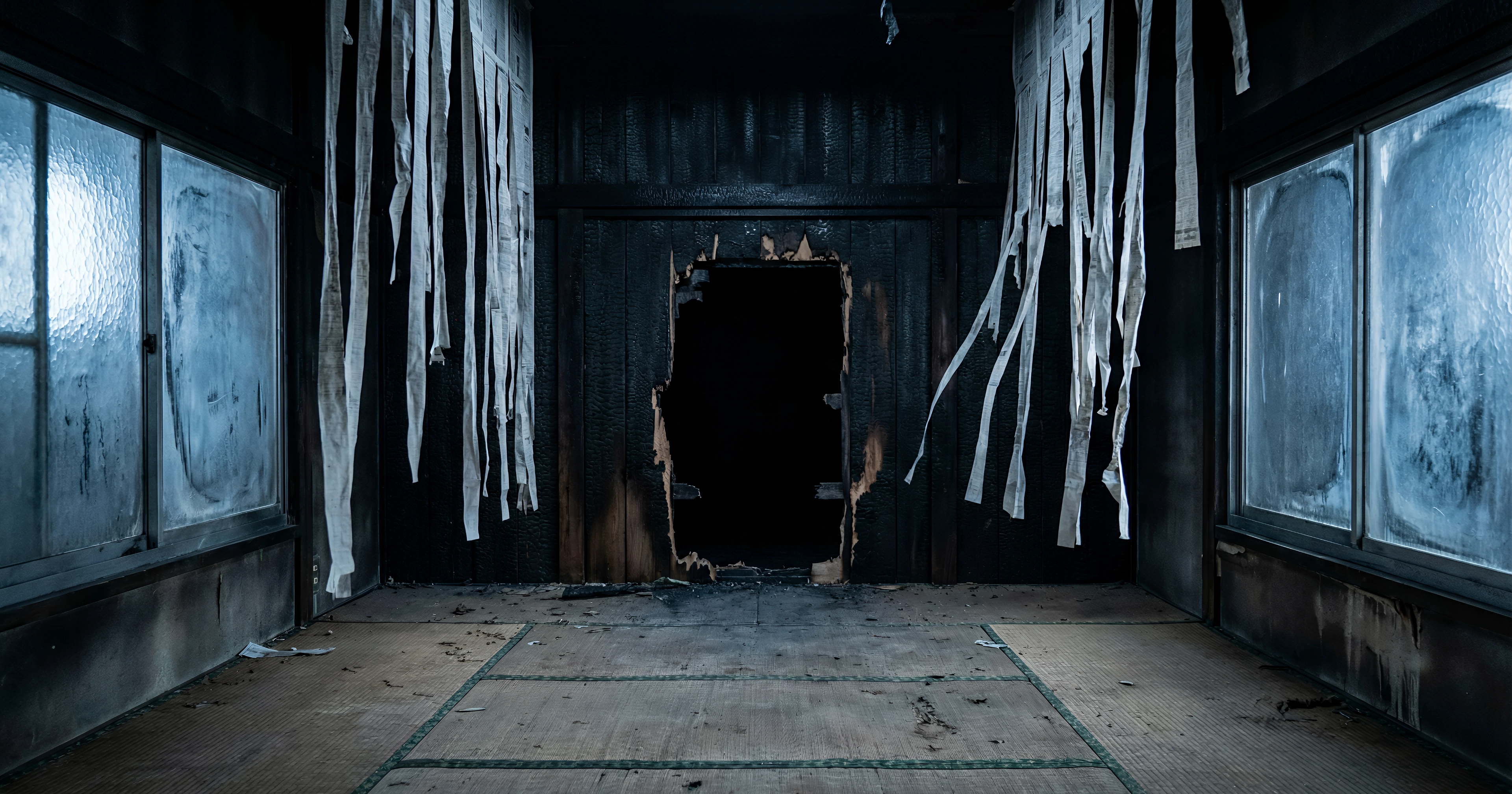
Yelena infiltrates a desolate mountain lodge to confront the elusive Shōgun Fukuyama. Inside the decaying structure, she must overcome a formidable guardian of immense strength and athletic prowess. The ensuing pursuit leads through the building's dark interior , culminating in a treacherous descent into the mountain’s ancient, subterranean depths.
FOUR
Showdown At The Ryokan
Every breath you take
Every move you make
I’ll be watching you
From the tree line I watch the ryokan and it watches back. The Thousand Eyes. A matrix of century-old Taishō glass framed in charred cedar so black the building disappears. Only the windows remain—floating, disembodied mirrors of moonlight that feel alive. Unblinking, ever watchful.
Why am I freezing my ass off out here?
“Patience—yuck,” the Other Me says, hunched behind the next tree. My Dark Self, the part of me that lurks within. She’s wearing the same Arc’teryx tactical gear, but hers is smudged with dirt and tree sap, like she dragged herself through the muck while I hiked the trail.
“I hate patience.” She squeezes her hands like she’s wringing a neck. “Let’s rush in and kill everyone inside!”
And that is why she is riding shotgun.
I’ve been out here for an hour—waiting for a sign, any sign, that someone is inside the ryokan. I listen for doors opening and closing, the creak of floorboards or muted voices, but all I hear is the wind in the trees. I watch for shadows passing behind the windows, but the glass is too thick, too imperfect. Light cannot pass through. The windows trap the moonlight and reflect it back as glowing, opaque lenses.
I do catch the faint scent of burnt wood in the air, but the chimney is dry. Could be a campsite upwind, or Shōgun Fukuyama knows I am coming and doused his fire.
What I am certain of is that I cannot stay out here any longer. The hike burned calories, generating heat that made me sweat, but I’ve been motionless too long. The residual warmth hiding inside my insulated clothes? Gone, leaving only the relentless cold, aching joints, and tired muscles contending with the weight of my pack.
“Fuck it,” I finally say before darting from the tree line. My Shadow cackles, “Yeah, fuck it!” but not behind me—in my head. Boots kick through dead grass and frigid ground, crunching the frost between strides. I move fast, not slow, choosing speed over silence. The moon is too full, too bright for me to hide, even cloaked in black. I run flat out for six seconds then put my shoulder against the remains of a stone lantern for momentary cover.
I begin counting. One, two, three… I lean to the right, until my right eye clears the lantern and the ryokan slides into view. Six, seven, eight… Breath mists through my balaclava as I watch the veranda, the windows, the entrance, but still nothing. No movement. No noise.
Ten. I’m moving again, curving away from the Thousand Eyes to the ryokan’s flank. The eave casts a hard block of shadow onto an engawa, the raised walkway that wraps around the exterior. No more running. I test my weight on the first plank. It holds but not without whining as the wood flexes. My breath hitches and teeth grit. The next step inspires more confidence. The harsh climate has warped most of the boards but this one doesn’t bend or creak.
I take a breath, then crouch slightly and begin. Not heel-to-toe. Too loud, especially with heavy-soled mountaineering boots. I begin with the outside of my right boot then gradually apply pressure while rolling forward and around the toe. Silence. My left performs the same motion, aiming for a board anchored to the support beams where the wood cannot compress so severely. I walk, hunched down, melted into the darkness, every step measured, calculated, and executed with precision, leading me to the door.
I take another step and then stop.
The large wooden door is open, slid towards me. I couldn’t tell until I was practically in front of it. Concerning, but the explanation is simple. A scavenger wandered through, didn’t bother sliding the door shut.
What isn’t so easy to explain? The incense.
I recognize the fragrance the moment I lean near the opening. Aloeswood. Deep, dark, and bittersweet—and expensive. Worth many times its weight in gold. Fukuyama could have doused the fire and closed the flue long before I made it up the ridge but incense lingers. Hours. Days. Depending on how often he’s been burning it. Was the door left open to clear the air?
No. This is a trap, a carefully constructed trap, and he wants me to know it.
I step down, landing softly on tile in the recessed entryway. Dead pine needles and frozen cones scatter the floor. Ahead, a dark corridor delves into the belly of the ryokan. I climb one step and continue deeper inside.
The corridor is narrow. Shoji screen frames line one side, the rice paper long disintegrated, leaving only the skeletal latticework. Moonlight filters through from the windows and into the hall, square shafts that break across my gliding shape.
More light ahead. Not the cool, natural gleam filtering through the windows, but a warm, orange glow, rising and falling in intensity like a breathing fire. My hand finds the yoroi-doshi sheathed behind my back and I approach.
The corridor terminates at the zashiki, a formal receiving room for entertaining guests and tea ceremonies. I look down. An oil lamp sits on the floor near the threshold. The flame gently bobs around the wick. Then I hear the clapping. Exaggerated, snide smacks, and in between each, a loud, brash chuckle.
I look down the length of the room. At the far end sits Shōgun Fukuyama in lotus position between two oil lamps. Their flames cast shifting amber light across his silk blue kimono, his only source of warmth in a bitterly cold room. His hands come together for one final, slow clap, then rest on his thighs while the pop still echoes across the room.
“So, you have finally shown yourself,” he growls, barking Japanese with the force of a man accustomed to obedience. A woven takuhatsugasa obscures his face above the mouth. “I have remained here for quite some time, counting the hours until our meeting.”
I let go of the dagger beneath my jacket and enter the zashiki.
“I shouldn’t be surprised to find you waiting for me,” I say, ignoring the stench of mildew from the rotting tatami floor. Explains why he’s burning through thousands of dollars of incense. Every step feels squishy as the mats sink into the subfloor. “My curiosity remains, however. Was it the clerk?”
“An astute observation,” he says. “Two-way radio. The moment he spoke of a suspicious gaijin of such a… unique description, your identity became clear to me. Indeed, my eyes extend far below this mountain—much like the many eyes of this house that observed you lurking among the trees. You remained out there for quite a substantial duration.”
Another step. What began as a ten meter gulf is now nine, then eight.
I answer, “An hour—roughly.”
“The air outside is quite merciless. Your body must be freezing.”
“I was,” I say, drawing closer. “Now, I have forgotten the chill.”
“To endure such a trial… it requires a truly disciplined spirit.”
I have cut the zashiki in half. This close, I can now see the effects this life has had on him. The Fukuyama I knew was a strong, capable warrior, not this frail old man with sunken jaws, skin sagging down his neck, and bone-thin hands mottled from malnutrition.
I also see the katana on the floor next to him, a reminder that even in this weakened state, the man is still dangerous.
I advance. “Surely not as much discipline as it takes to rot in this place for an entire year, simply to evade me.”
His hand fires into the air—flat, palm facing me. The sleeve of his kimono spills down his thin arm. It stops me in my tracks.
“Sharp tongue,” he says with a smirk. “You are correct, naturally.” His hand lowers, but I remain in place, four meters between us.
He continues, “When my assassin proved inadequate, I was faced with a choice. To send more men and risk scrutiny of the authorities—or to wait for you to seek me out yourself. And thus, we arrive at this moment. I am merely surprised that you required such an extensive period of time to reach me.”
He’s right. I allowed myself to become distracted.
Never again.
“And here I stand,” I say, holding my arms out. “Yet, you have made the mistake of facing me without any men to stand between us.”
He responds with a single, mocking chuckle, then punctuates it with calculated disrespect—and a threat. “Gorgo-kun, I am never truly alone.”
I don’t have time to dwell on the insult. I’m more concerned with the booming footfalls vibrating through the floor.
My eyes lift past Fukuyama to the massive door at his back—an itado mounted on steel rails, built from the same charred timber that is the bones of this ryokan. It would take an incredible amount of force to disturb it, and yet it rattles with every impact. Thunk-thunk—every strike is a hammer crashing into an anvil.
Fukuyama smirks. “Hmm.”
The itado doesn’t slide, it launches, rumbling left on steel rails until it slams into the end post like a struck gong. The mountain enters in many forms—the groan of hundreds of trees losing the fight with the wind, the bitter cold that rushes in to sap the last remnants of heat trapped inside the zashiki—
And the giant who follows.
A man so tall he has to duck to pass through the threshold, shoulders so wide they brush the frame as he crosses it. His steps are louder now, pounding beats as he slowly unbuttons the tailored jacket and slides it off his barrel-thick arms.
Fukuyama’s left hand whips into the air like an exclamation. “Now then, Gorgo-kun. Look well upon this man. I shall grant you the honor of an introduction: this is Konda Raijin.”
Raijin. Thunder god. Great.
The jacket crumples after hitting the floor. Konda is the biggest man I’ve ever seen. He doesn’t walk, he marches like a war elephant but there is an unexpected grace in his gait. He doesn’t lumber or stomp. This man is more than fat and muscle. He is an athlete.
Fukuyama’s hand whips, palm up, to proudly gesture at the goliath. “In another life, he stood atop the clay of the Makuuchi, feared by all as Raijinoyama—the Mountain of the Thunder God. When he performed his tachiai, the initial charge, the gods themselves would stop to listen to the ring-rattling thunder of his impact.”
Konda faces me. His soup-bone hands meet, lacing fingers together, then flex to crack every knuckle.
My neck has to tilt for my eyes to meet Konda’s narrow glare. I’ve never fought a man of such size and strength. I am reminded of the heavy assault pack weighing down my shoulders. I say, “Pray, grant me a brief indulgence. I wish to divest myself of my burdens before you proceed with my certain execution.”
He looks to Fukuyama for approval who, after a brief consideration, receives an approving tip of the takuhatsugasa. His eyes snap back to me. He nods.
I turn and walk several paces while letting the backpack slip off my shoulders. The moment it drops, my body thanks me. Shoulders shrug as my neck rolls around the joint, stretching the overworked muscles, loosening the tension from the hike. The zipper releases, my insulated jacket opens and I face my foe, denying him my back. Only then do I shed the outer layer and drape it over the bag, ensuring it doesn’t touch the moldy tatami.
“A sumo wrestler, huh?” I ask while removing my gloves. They go on top of the jacket.
Fukuyama laughs. “Ha! You have a cynical soul, like your father. The Sumo Association is a collection of shriveled old men in silk robes. They have no stomach for a man with a true thirst for life. When they discovered Konda’s… extracurricular dalliances with the gambling world, they saw only a fixer of matches. They discarded him like common refuse. But I saw a spirit too vast for their narrow rules. I reached into the mud and retrieved the 'Thunder God.' I gave him a new purpose.”
The balaclava is last. I hook my thumb underneath the neck and peel the wool up my face. Sweat-slick skin meets cold air in a rush, chasing away scattered thoughts brought on by fatigue. The mask is tossed on the pile. Stripped down to my turtleneck, pants and boots, I walk back to the two men, but stop short of my original position. A large gulf of open floor now separates us.
“That's a very interesting story, Shōgun,” I say while finding proper footing, two spots properly spaced, on sections of tatami still firm. I then crouch into a ready stance and lean forward. My left arm bends at the elbow across my torso while my right moves back so my hand rests against my hip.
I add, “I suppose even a mountain can be moved if the price is right.” Spoken to Fukuyama, but my eyes are fixed on the sumo.
Konda growls under his breath, like a bear about to charge.
“It seems our guest is finally prepared,” Fukuyama says, half his mouth curled in confidence. Then suddenly his voice breaks into a shout. “Konda! Proceed with her destruction!”
Konda roars like a beast, then lunges forward. His thick legs power his giant boots into the floor, driving his mass forward like a boulder barreling towards me. I watch his right arm cock back over his shoulder, study the fist tightening into a battering ram. The floor thrums like a battlefield beneath a charging army.
I breathe in—and The Hunger breathes out.
Legs push off the ground. I rise level with his chest, giving him a target for his fist. He accepts, throwing the battering ram at my face but I have already moved.
I drop back into a crouch. His arm swings wildly past me, leaving his belly open for the taking. Right hand leaves my hip and thrusts into his left upper quadrant, but my hand isn’t empty. The yoroi-doshi pierces through skin, fat and muscle to the hilt. Most victims would stop immediately, but a big guy like him? Too much momentum. He takes another two steps, and the motion draws my blade transverse across his abdomen.
I lock eyes with Fukuyama and I give him a very Spiral-like smile.
“It cannot be,” he mutters, and for the first time, I see fear he cannot hide, even behind that stupid basket he's always wearing.
My arm remains wrenched back, fingers white-knuckled around the yoroi-doshi still sunk in Konda’s side. The sumo is screaming—loud hacks of pain and panic. Then I hear something else—splashes hitting the floor—a succession of heavy, sodden slaps landing in rhythmic squelches.
His wails are now nothing more than hitches of dying breath. I rip the dagger out and he falls away from me, collapsing on the floor like an avalanche. The smell that follows is sweetly grotesque. Coppery-tang of arterial spray mixing with the wretched stench of perforated bowels.
My voice is ragged with laughter as I clean the blade on his thousand dollar pants. “Someone has been eating a lot of seafood,” I say with a hack. The mask has not simply slipped. I skinned the person suit down to the meat and bone, and now only the appetite remains.
Now (mostly) clean, I point the dagger at Fukuyama as I rise to my feet. “Let me guess,” I say in brutal English. “You sat up here all this time eating rice balls and drinking well water, but you let the fat man go down the mountain for fish heads and sake. Needed to keep him nice and plump for ol’ Yelena, hmm?”
The Shōgun snatches the katana and brings it to bear, the tip of the saya striking the wood. “You are a gutless cur”—he growls, leaning on the sword as a cane—“who uses steel against an unarmed man. A man who fought with honor—not treachery.” He rises to his feet, strengthened by defiance and self-preservation.
“He should have armed himself then.” I back away slowly. Not a retreat, though he is welcome to indulge in fantasy. “His mistake.”
Fukuyama’s right hand flies to the handle like a viper strike. The sword draws—chhk! Smooth, fast, practiced. The saya is tossed aside, and his left clenches the tsuka beneath its twin.
“That is not a mistake I will repeat.”
Boots tread backward through Konda’s filth, blood and muck sticking to the outsoles, until I clear the murder scene and reach my bag.
He bursts with laughter, a boisterous har-har-har. “Well, isn’t this something. Gorgo-kun running away?” He climbs down from his dais, thick tabi socks with split toes finding expert footing on the tatami. “You disappoint me.”
“Running away?” I snort, then flip the dagger to my left hand before dropping down next to my assault pack. Hand finds the koshi-nata, fingers tighten around the hilt. The blade rips free in one clean pull, brushed metal flashing in the lamplight.
“I never run from a bad deal.”
I leap to my feet, take three steps forward, and after a lightning flourish, settle into an offensive guard—the machete trained over my shoulder, the dagger in reverse grip across my chest. My grin curves ever wider.
“I alter the terms.”
Fukuyama’s takuhatsugasa tilts forward. His lips purse together, jaws clench. I can hear his teeth grinding. The fucker has the advantage. The katana’s reach in open space is the problem. I must breach his guard. There the nata will cleave through flesh and bone. But getting close might require a sacrifice. I let his blade open my shoulder, or glide beneath my arm to slice against my ribs. Then, when we get up close and personal, and the violence becomes intimate, there will be no—
Fukuyama doesn’t advance. He flees, leaving me blinking as he escapes into a dark corridor, disappearing deeper into the ryokan.
I lower my blades and yell after him, “Where are you going? I thought we were going to play!” I gnash my teeth together and cackle like a hyena. “Fine! New game… hide and seek!”
I race after him into a corridor that tries to kill me before he does. Decrepit shoji line the walls, the frames splintered into sharp hooks snagging my sleeves when I pass too close. Blackened tatami mats sag under my boots, bowing between support beams so each step is a gamble—one patch is firm, the next squishes like wet sand.
The red moon knifes through structural decay, carving passages into stuttering bands of light and blackout. One stride lit, the next blind. A strobe-lit hunt. I dance between beams and dust motes, singing, “Run, run, run—time to run and hide! Run, run, run—and now I’m going to find you!”
I catch a flash of blue silk cutting through a ripped shoji. I don’t slow down. I angle my shoulder and burst through what’s left of the lattice, the wood scraping my arms.
“I’m gonna getcha!” I howl as the air changes around me. Colder and mineral-thick, like the taste of stagnant water and long-closed spaces. No incense here. No mildew-sick stench. Something else breathes beneath the floor—something pungent and earthy.
I skid to a halt inside the doorway, my chest heaving, heart pounding. The floor is littered with shards of wood and frozen straw, the remnants of the collapsed roof. The moon pours past the joists, projecting a pillar of light onto the far wall. In the middle of that column is a passageway.
A rectangular maw cut straight through the planks. No door. No rail. The opening is wide enough to roll a stretcher through. A chute.
Oh. Oh. Oh! You clever bastard.
I remember what Mr. Skulker said before I fed him to the incinerator, about this place being built during the Spanish Flu pandemic—back when 'isolation ward in the mountains' sounded like salvation instead of a death sentence with scenic views. He said the desperate rich were brought up here by the wagonload. Promised the healing magic of the mountain air. Got fever and drowning lungs instead.
Bed after bed filled. Bed after bed emptied. But up here on a ridge, the ground is frozen rock under a dusting of soil. No graves. No cemetery. No pretty marble stones.
So they cut a hole into a lava tube. Slide the problems away.
Wheel the gurney to the lip. Transfer the corpse to the base of the chute. Push. Gravity feeds and the mountain swallows the evidence. Out of sight. Out of mind.
Fukuyama’s voice echoes in the throat of the earth. “Why do you hesitate, Gorgo-kun? Afraid of the dark?” His raspy laugh pisses me off more than his words. I don’t think. I can’t think. The Hunger must eat, eat, eat.
I jog to the edge. The chute gapes down into near total darkness, descending to a single pinpoint of light at the bottom. Too steep to traverse, but there is a heavy rope anchored to a bolt hammered into the basalt. I sheath the dagger behind my back then grab the rope.
The draft curling from the chute has a faint odor. Gas vents are a concern but it lacks the rotten egg stink of sulfur. This is… mossy—wet moss and mud, like a forest after the rain. What, he’s got a terrarium down there?
First step. I test the surface. My right foot presses down on the basalt—the tread slips immediately. Angle too high. Friction too low. This isn’t a tunnel. It’s a slip’n’slide. The rope is for the climb up.
I sit at the lip, legs dangling into the dark.
“I always did prefer the chutes over ladders.”
I push off and immediately I’m falling. The machete is held above my head. I am lost in the dark, catching only hints of reflection off the black rock. My shoulders scrape along basalt smoothed by time, my boots finding nothing to push against to slow my descent. Air knifes past my ears, damp and cold, dragging after it the mineral fetor from below.
Five meters. Ten. I bury my chin in my chest and look down. The pinpoint of light has resolved into a cave floor and it’s rapidly approaching.
Something crawls up the back of my neck.
I can feel it, yes—lightning shoots through nerves, yanks muscle without asking permission. Every hair on my body stands tall. The world narrows to a single word.
Trap.
I swing the koshi-nata in a powerful arc. Blades collide—the bright metallic scream rattles my teeth. In a heartbeat, my back clears the chute as blades skid apart violently. The katana cuts through my breath as it whispers past and I spill out onto the cave floor. Still basalt, but rougher. More friction. Better footing. Keeps me from flying over a ledge not two meters from the bottom of the tunnel.
I scramble to my feet, nata still clenched. Fukuyama attacks, a straight downward strike to my face. That’ll ruin my Saturday nights. I swing the nata across, parrying the sword. I seize the moment, swinging the nata with my backhand, aimed for his throat—but I’m not minding my footing.
He kicks me in the chest, hard—with more power than I thought possible. The force pushes me back, my boot grinding across loose rock too close to the edge. I hear the ledge crack but my balance is off. When the basalt crumbles underfoot, I’m already falling, and the world drops out.
The fall is quick but the landing is punishing. I slam into the rock on my back, the impact thundering through my spine and punching the breath out of me in one violent gasp. The back of my skull clips stone and my vision whites out in a heartbeat. In the confusion, my hand loses the machete. I hear it shriek against stone, then clatter on the ground.
The flash fades, sight returns. Heat wraps around me, wrong for winter—close, humid air leaking from steam vents in the rock. I try to breathe but my diaphragm is spasming. On the ledge, I see Fukuyama’s silhouette lean over the edge, his blade a silver line in the gloom.
I ball my fist and slam it into my solar plexus. The muscle relaxes and I exhale the trapped air to make room for the next big lungful. The air tastes like stone dust and stinking forest. Fuck, it reeks. I lie there, staring up, chewing my tongue in anger as my fists beat the ground. A snarl retracts my lips and I start to SCREAM.
Scrrritch! Crack! Fizz!
Light floods the cave, bright as the sun, spilling over me like judgment. I push up onto my right elbow and shield my eyes from the glare. At my feet, sparks shower to the ground, exploding on contact in sharp snaps and pops.
The glare dims and I look up through my fingers. Fukuyama’s silhouette dominates the jutting ledge I just fell from, cloaked in white fire from a magnesium flare held aloft. The katana is in his off-hand, blade trained on me.
His voice booms, amplified naturally by the cave’s volcanic geology.
“Welcome to the bottom, Gorgo-kun.”