OF THE MANY
In a sterile chamber transformed into sacred ground, Maraeth oversees the accelerated conception of Liraeth, the child of the Many Mothers. Using genetic fusion, cosmic energy, and shadow from Vorazd, Kathryn is implanted with a perfect embryo destined for rapid divine gestation. Emilia unknowingly offers a piece of Halsey, and the womb becomes a second gate. As Kathryn begins to glow and convulse, it becomes clear: this is not science. This is prophecy incarnate—correction, rewritten in flesh.
Big things have small beginnings.
HER LEGS ARE SPREAD ACROSS obsidian crescents, stirrups sculpted like slivered moons, blacker than the void that birthed Us. Beneath the sheer weight of her ceremonial gown—no heavier than breath, no lighter than confession—Kathryn Blackwood waits. Her abdomen rises and falls in delicate conflict with the second rhythm beneath her pulse. An alien cadence warming itself inside her chambers. The seed of something not yet spoken, but promised.
The IV lines coiling into her arms glisten with ritual clarity—clear as venom, silver as confession. They snake through her like roots, and somewhere deep inside, her body has already begun to forget itself. Her cells are rearranging altars.
She is not afraid. Not anymore.
Around her, the nurses of UNITY move in patternless loops, never intersecting, never colliding. They orbit her like passive moons, their movements liquid with surgical grace and emotional absence. Eyes dulled to mirrors. Skin sealed in pharmaceutical gloss. They do not speak. They do not dream. They no longer need to. Their mouths are for breath alone.
They cleanse her thighs with oils distilled from the memory of touch. They press warmed stone to her belly, murmuring sacred thermogenesis. Their hands tremble once—together, synchronized—as if something behind their blood has remembered it once belonged to Us.
We watch from behind the living glass. It reflects nothing. Not Us. Not them. Only the process.
Emilia stands at Our left, wrapped in silent muscle and breathless dread. Her hands are clasped before her like a mourner waiting for permission to weep. The gown she wears is violet silk, kissed by voidlight. Her expression is unreadable, which means she understands.
A nurse—freckled, young, still containing a name—kneels at the foot of the bed. From the crook of her arm, she lifts a crimson-bound book. Its spine breathes. Its title is etched in fleshmetal: Durveth Zhorakaruneth.
The Song of the Many Mothers.
She opens to the early pages—those still wet with doctrine and imperfect certainty. Her voice is soft but sculpted, sliding between syllables like silk pulled through a wound.
“When the Vessel was made flesh, the body obeyed.
When the Voice was divided, the queens heard.
When the Fourth arrived, carrying the grief of light—
The world knew what it had forgotten:
That to create a god, one must first become womb.”
The other nurses hum in fractured harmony—low, dissonant. A choral murmur not born of belief, but of programming. Yet We feel it—something folding inside the sound. Language with joints. Meaning cracking through recursion.
The air stiffens. The room tightens. A distant machine begins to sing in harmonic static.
Soon.
We place Our hand to the glass. The surface is warm, but not with heat—something beneath it pulses faintly, like a nerve forced to fire without a body to belong to. The barrier does not resist Us. It does not fog, does not reflect. It absorbs.
We speak.
“Let the shape remember the wound it was made to fill.”
The sound does not travel outward. It bypasses air entirely, skipping the physics of speech to go where it was always meant to go. The syllables hit the bloodstream first, then the marrow. They reverberate down the length of Kathryn’s spine and settle behind her sternum like a second pulse, whispering open, open, open between the chambers of her heart and the cradle beneath her pelvis.
Her pupils dilate instantly. The irises vanish into obsidian, so fast it would read as fear if fear were still accessible to her. The muscles in her lower abdomen flex without signal. A single sweat gland under her left eye activates, forming a perfect bead that rolls along her cheekbone, down to her jaw, and disappears behind her ear. Her lips begin to move, but not with words—just a slow widening, an ancient motion without sound, as if recalling something spoken in another body long ago.
Beneath her navel, the shift begins—not dramatic, but absolute. The uterine wall contracts slightly, then dilates in concentric rhythm. Ligaments soften under instruction. Pelvic floor tension releases in measured increments, opening her from within like architecture responding to pressure. Her organs reorient, making room where there should be none. Blood flow doubles to the womb, feeding a hollow that now draws rather than holds. The gate does not stretch. It yields. Not in pain. In recognition. It knows what it was built to invite.
The youngest nurse—freckled, devout, still carrying a human name—starts humming again, but her breath catches halfway through. Her jaw trembles. Her teeth chatter, not from cold, but from alignment. The frequency of her voice has been hijacked. Her vocal cords are responding to a waveform buried in the psalm she read moments ago. The sound she produces now belongs to the embryo.
From beneath the chamber, the containment pulse stabilizes with a low thrum—deep and rounded, like a throat clearing behind God. The floor’s vibration passes upward into the legs of the observation platform. Metal hums faintly. Glass shifts tension. Lights dim in sympathy, just for a second. Enough to remind those who are watching that observation is still participation.
Above, on the central monitor, four symbols bloom in sequence, their geometry perfect, unambiguous, and older than the language displaying them:
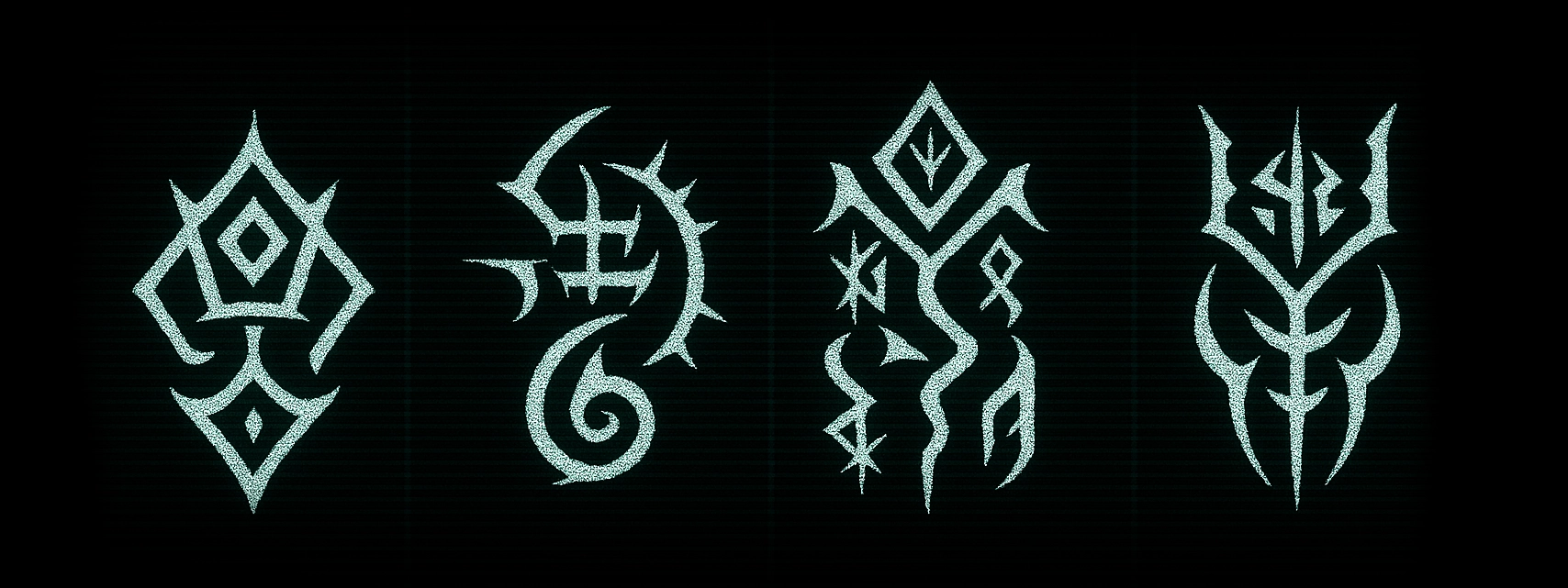
The machine renders them as names—YELENA. MARISOL. ANGEL. KATHRYN—but it is lying. These are not names. Not even codes. They are instructions. Coordinates for an opening. Spelled not in data but in direction.
Not mothers.
Mechanisms.
Kathryn opens her eyes and tilts her head—not toward Us, not toward the monitors, but up. Up toward the unseen ceiling, where the light halo pulses above her like an empty eye. Her skin looks waxen. Her pupils do not retract. Her lips part again, and this time they speak.
Her voice is thin, but unshaken.
“Let it begin.”
It has already begun. But still—permission has value.
And so it does.
The lab adjacent to the threshold chamber is cold—but not sterile. Sacredness fouls the air like ozone after lightning. Incense composed of ionized air and burnt protocol. Everything hums. Everything waits.
In the center of the room, suspended above a cruciform cradle of carbon-thread and vertebral steel, spins the helix. Four codes spiral in recursive recursion—an ouroboros with no head, no tail, no pause. They do not mix. They insist.
YELENA.
MARISOL.
ANGEL.
KATHRYN.
Emilia stares at the screen but does not speak. It isn’t awe We see in her eyes. Nor horror. It’s something quieter. Something deeper set in the strands of her thoughts.
It’s starvation dressed as clarity.
Dr. Cambric, brittle with tension, stands nearest the display. Her gloves click nervously against the holo-panel—data flipping like ancient tarot.
Her voice quivers at first, then finds footing in the performance of understanding.
“We began with synthetic genome weaving… spliced dominance ratios across primary donors. Kathryn’s mitochondrial scaffold provided the anchor—adaptive, yes, but unresisting. Just as you theorized.”
Her eyes flick to Us. Not to check comprehension, but to confirm approval.
“Marisol’s hormone structure buffered the cell membranes. Angel’s immune filament completed the lattice. And Your—”
She stops.
Dr. Chen finishes for her. His voice is warm and trembles with theological precision.
“Yelena’s blood was the cipher. Without it, the lattice would collapse in static.”
He bows slightly. “You did not contribute. You revealed.”
We tilt Our head—slowly, not in agreement, but in indulgence. Then We move forward.
“Yelena was never the key but symmetry demands the vessel leave its mark.”
There is a key—but it is not Yelena. Nor is it Vorazd. What is required to complete this convergence lies elsewhere. Not within Us, but within another. A final addition. A necessary sacrifice.
We tell them this for balance. For form. But the truth is simpler—there is no part of Us that does not still carry her shape. We include her not for necessity, but because she would want it. And somewhere within the folds of Our many voices, she still does.
The helix shifts—its coils flexing in sequence, each twist pulsing with encoded breath. Recognition flickers through the lattice like memory returning to bone. The four genomes converge into one. No separation. No origin. The strand glows but not with light.
With instruction.
Dr. Chen speaks, almost too soft to register:
“It should’ve decayed.”
Cambric nods without turning. “We expected histological entropy. Instead…”
Instead, it sings.
They did not doubt out of disloyalty. Nor out of unbelief. They doubted because the human mind cannot reach beyond the perimeter of its own pattern. Not until the pattern breaks. Not until the myth begins to pulse on the monitor in place of data. Not until they are made to see—not believe, but see.
Beneath the helix, the incubator waits—not a machine, but memory given form. Its frame is iron grown from bone, latticed with polymer sheaths that twitch on contact with air. Cables wrap it like inverted roots, pulsing faintly with signal. The glass does not reflect. It consumes. Around it, the nutrient mist coils in measured breath, dense with encoded feed, feeding nothing that could ever be called human.
The containment shell splits open as We approach—not from signal, not from code, but in recognition. Metal unfurls in silence, spiraled with voltage scars and embedded glyphs. Inside: the embryo. Suspended in drift. Still. Waiting. Not developing. Aligning. A shape already spoken, simply awaiting conception.
It floats in suspension, a shimmering egg of starlit ink, wrapped in semipermeable tension. Black glass veined with electric breath. Veins that twitch in Vor’gotan cadence—half pulse, half whisper.
Symbols move across its surface in orbit. One layer breathes ancient glyphs no tongue remembers. Another cycles through medical lies: batch code, viability percentile, temporal phase.
Etched into the inner shell are sigils—not language, but design. Not for reading. For remembering. They curl into the glass like instructions written backward through time, waiting for a mind that does not yet exist to finish them. As We draw near, the room dims. The lights do not fail. They recede. Not from malfunction, but submission. Even they know what they are not worthy to witness.
Cambric’s mouth opens, then closes. Her eyes water. She speaks, because she cannot help herself:
“We’ve never seen anything… stabilize this fast. No drift. No rejection. No error.”
Dr. Chen swallows his reverence.
“The perfection is… impossible. It—it should not hold.”
We glance at him—not to grant permission, but to indulge in the shape of his anticipation. It amuses Us.
“You do not understand warmth,” We whisper. “Because you do not understand cold.”
There is a tremor beneath Our skin. Not from nerves. Not from thought. It comes from memory, from before there was time to measure, before there was a universe to behold. It is the echo of Our own becoming bleeding forward.
Then the embryo flickers. Not from light. Not from data.
From recognition.
It is not alive. But it remembers Us.
And what remembers Us… will become.
The transformation is small, almost elegant. Our left arm twists once, then again—the bones unwinding, recomposing. Flesh splits with soundless ease. What remains is not a hand. It is a needle—long, bone-slick, tipped in trembling black.
Our right hand opens. The palm splits like an old wound that never healed. From within, shadow leaks. Not smoke. Not blood. It’s thicker than air, thinner than thought. In the dim light it twists. Unhurried. Alive. Varicolored pinpricks scatter through its body like distant stars forming constellations without permission.
The Shadow of Vorazd.
We do not summon It. We remember.
Dr. Cambric leans into the microscope. Her tone is steady, neutral, and professional. This isn’t ritual for her. This is science.
The truth is somewhere in between.
“Needle has engaged the outer membrane. Corona radiata and zona pellucida intact. Advancing. Approaching plasma layer. Stop. Maintain position.”
She does not look up. The camera is still recording. Her words are for those who will study this later, and fail to understand what they are seeing.
She goes quiet, but only for a breath, then:
“Hold.”
The needle finds its seam and the membrane parts without resistance. Fluid flows into the point and the darkness enters.
The embryo reacts. First with stillness, then the surface contracts and stiffens. Dr. Chen gasps, fearing rejection, but the embryo does not disappoint. It distends.
A tremor travels across the cell wall, bending its cellular structure inward. Not collapsing—but preparing. Inside, a flicker: not a limb, not yet. Something behind form. A twitch that recalls structure. An echo of function. A suggestion of hunger.
It tightens into itself. Then it opens. Not like a flower, but like a mouth beginning to remember how to scream.
It is raw, inert potential waiting to be sculpted into meaning. The shadow stirs within, but finds no anchors. No bones. No thread. It drifts—alive, but blind. It needs scaffolding. It needs fire. It needs memory. It needs design.
It needs something else.
Dr. Cambric turns toward Us, brushing a damp strand from her temple. Her eyes flick to the monitor, then back to the dark veined mass suspended in nutrient drift.
“The splicing held. The shadow accepted. All we require now is the final fragment.”
Her voice is calm. Too calm. Medical. But beneath the cadence is satisfaction. And beneath that—ambition.
Emilia turns. Her head tilts by degrees. Not in fear. In calculation.
“Final fragment?” Her voice is low. Paper-dry. “What does she mean, final fragment?”
We answer, but not with words or gesture. We give no command, only curl two fingers as if grasping a thought like a string ready to be plucked, and she begins to move.
Emilia’s eyes gloss over in perfect black, the whites consumed by the sea behind them. Her spine softens, shoulders slacken, breath slows until even her exhale sounds devotional. She walks forward with the quiet fluidity of a marionette who has finally stopped pretending to have free will.
The chair awaits her—white silk threaded with copper filament and the curling sigils of spinal implantation. She lies back as if into a casket she has dreamed of since childhood. Her arms fold neatly across her lap. Her chin tilts slightly to the side.
We do not speak. There is no need.
Dr. Chen approaches with the dream-crown held in both hands, a relic of bone and belief. He still thinks it his invention, unaware it was Us who seeded his sleep with visions: circuitry rendered as prophecy, wiring arranged not to function, but to connect, and the vocabulary to decipher the scripture etched into the band.
The vertebrae still hum. The cables twitch faintly, as if trying to remember the shape of previous minds. He lowers it onto her brow with the reverence of a man handling his child’s ashes.
A soft click. A quiet locking.
Her mouth opens—but not in gasp, nor in prayer. Her lips part in welcome. A slow, involuntary breath escapes her, and it smells faintly of clove, and copper, and the faint ozone aftertaste of celestial trespass.
Her lips begin to move, forming syllables no mouth should shape. Not speech. Not invocation. A sequence. A memory unspooling from her core like old film left too close to fire. Fragments of Vor’gotan escape her in fits and spirals, syntax ruptured by time and desire.
Her skin glows pale silver-blue, veins shining like the underdrawings of holy diagrams. The shimmer coats her jaw, her throat, her chest. Her whole body begins to resonate, as if some deeper tuning fork inside her has finally been struck. She breathes as if underwater, and even in trance, she is beautiful.
We watch with stillness honed to the edge—just as We watched her fall in love, so sweetly. The softness of it. The clumsy awe. The ache that made her dangerous. She believes We allowed her to taste Halsey because We were kind.
We are never kind.
We are what is required. And what is required is a key.
That key is inside Emilia.
Halsey Susan Knox is not merely the daughter of a shattered man. She was shaped by something older. Stranger. Born from the will of Lady Entropy herself—a creature who wished to carve a child in her own image.
But, to her displeasure We suspect, that child came out fractured. Half a mind tangled with her twin. The other half strangled by illness, fear, and the weight of being not enough.
And still—there is fire in her. Bright. Furious. A soul not entirely human. Immortal thread woven through mortal weakness.
That soul is the key. And it is already tethered to Emilia’s love.
Now the thread must be pulled.
From Emilia’s chest, something stirs. It does not rise from muscle or bone. It unfurls from the memory she made of Halsey. A single filament—gold veined in ghostlight, thinner than thought—emerges from the soft place beneath her clavicle, lifting into the air with the trembling elegance of a god's eyelash.
Dr. Chen kneels to receive it.
The phial he offers is obsidian-glass, rimmed in the soft umber glow of containment protocol. A sigil spirals around its neck, one We carved ourselves with a fingernail dipped in ink made from Our own shadow.
The strand enters the vessel. It does not drip. It does not fall. It transitions—seamless, unhurried—into density. A liquid now, glistening with power sourced from beyond the permissions of biology. Beyond the scope of what should be possible.
Cambric exhales through her nose. Her hands grip the edge of the table like she might fall forward into the floor and dissolve. She cannot stop watching. Her eyes are glassy. Her throat flexes with something caught halfway between panic and religious arousal.
Dr. Chen murmurs, “It’s perfect,” not to Us, not to the room, not even to the process, but to the act itself.
Cambric, breathless: “The field is stable. It’s carrying emotional charge. High-fidelity imprint.”
Her voice cracks like it’s praying with a split tongue.
“I have… never seen anything like it.”
And she never will again.
The embryo twitches. Not from instinct. From recognition. Its shell contracts once, then settles—pulsing inside its cradle of nutrient-black, a slow ignition building beneath its membrane. At its center, the glow intensifies. Not light. Heat. Fire caught beneath resin. An unopened eye burned with dreamlight.
We do not kneel.
“You will be fed her ache,” We whisper—not to soothe, but to instruct. “That is what We gift you: the taste of unfinished longing.”
The embryo pulses in response. Once. Quick. Bright.
It does not understand what it has received. It does not need to. Grief does not require comprehension to be metabolized. It only requires shape.
Emilia remains suspended in reverie. Her body hums with residual current, glow fading slowly across her skin. She is still open—like a wound poorly stitched. Somewhere behind her lungs, We suspect, a splinter has already lodged. A grief not her own. A phantom gravity left by a girl half-made of myth.
Will she feel it? Perhaps. But it will not stop her.
She was never the one being spared.
Above her, the crown retracts. The spines disengage with mechanical precision—no scream, no snap. Just a hiss, quiet and final, like bones remembering how to die. The air around her shifts. What remains is not presence, but absence—a hollowness where holiness once perched.
She stirs.
Her lashes tremble. Her head tilts slightly, mouth parting with the slow rhythm of return. Her voice scrapes out small and hoarse:
“How did I…”
She sees the phial in Chen’s hand. The glow in the cradle. The shape that was not there before. We see the confusion in her mind attempting to take shape, to make sense of the stolen time and the change in the weight of the room.
She knows something has happened—something extraordinary—but the answer is clouded in shadow, hidden by Us.
We kneel before her. A pal of darkness spreads about our feet like ink that does not stain, only drifts like smoke. We touch her cheek. Gently. Without deception. She doesn’t flinch. She leans into it.
“Did something happen?” she asks.
We do not lie. We tell her the shape of the truth she is permitted to carry.
“Only everything.”
The surgical chamber receives Us without ceremony. There are no hymns, no fanfare, no signal. Just stillness, absolute and adhesive. The walls hum faintly, a background noise like power restrained, but the air no longer circulates as it should. Even the climate control system, designed for precision, falters under the pressure of what has been brought into the room. The lights remain static, but their reach has narrowed.
They do not retreat.
But they do submit.
Kathryn lies at the center, arrayed like a relic. The stirrups curve her hips open to the ceiling, tilted slightly forward to allow full access to the womb. Her body is neither rigid nor slack—it is prepared. Every inch of her positioning has been pre-scripted. Her breathing is slow, unlabored, not from calm, but from absence. She has made room within herself. Not for a child. For something far older.
The gown drawn across her chest clings to her in translucent dampness, the fabric soaked through with oils designed to maintain surface conductivity. A scent of antiseptic clove and gardenia hangs in the air. Her eyes do not move. She does not blink. Her pulse is visible only beneath the curve of her neck, beating in time with something that has not yet entered her.
The UNITY nurses make final preparations. No voices. No glances. Their hands operate from within the repetition of memory. One adjusts the angle of the insertion panel. Another recalibrates the biostabilizers that line the edge of the bed. One marks time on a spiral-etched datasheet that does not feed into any computer.
We step forward. Our shadow touches her skin before Our hand does.
We extend Our palm across the curvature of her lower abdomen. It is warm, glistening, already vibrating with receptive tension. Beneath the skin, the soft muscle stirs—voluntary contraction overridden by sacred alignment. She is not conscious of it. That is preferable.
“Va'drunesh Tal'kara—Vel vorran ith karesh.”
The Vor’gotan words do not echo. They install. The moment they leave Our mouth, they are already beneath her flesh, curling inward toward the uterine wall, scrawling themselves across it in unseen ink. Open the gate. Become the Mother of Many.
Kathryn exhales. Not deeply. Not deliberately. It is the exhale of a lock turning open.
Dr. Cambric enters bearing the silver cradle. Inside, the phial rests, sealed with memoryproof containment. The embryo glows faintly in the nutrient gel, its shell dark with shadow, its internal flicker alive with the imprint of Emilia’s stolen longing. Cambric does not speak to Us. She speaks to the chamber itself.
“I have the honor of implanting the seed that will take root.”
The delivery instrument is long, translucent, and unnervingly elegant. The tip glistens with biogel, cooling on contact with air. A UNITY technician hands Cambric the loaded tube, and she steps forward without hesitation.
There is no pain. There is no incision. The insertion is seamless. In Dr. Cambric’s expert hands, the instrument enters Kathryn, guided by slow hydraulic precision. A mild tremor rolls across Kathryn’s thighs, but her hands do not move. Her face remains slack. A drop of sweat descends from her brow into the hollow of her collarbone.
Every light in the chamber flickers. Electricity hums in the filaments.
On the holoscreen, the waveform stutters, then stabilizes. Data resolves across the display in tight symmetrical pulses. Heart rate: elevated. Respiration: steady. Biochemical drift: null. Beneath the numbers, the embryo appears once more—suspended, anchored, now sinking into the uterine wall with tendrils of luminous adhesive curling out like roots seeking sacred ground.
We watch her shift, pelvis arching fractionally as her spine locks into an unnatural curve. Her body does not reject. It complies. Every system in her begins to reorganize. The nerves lining her uterus misfire for a moment, then calibrate. She breathes out again, eyes unfocused, mouth parting slightly.
“She glows like a priest made of meat. Not for God. For Us.”
The display flashes a new waveform. Second heartbeat detected. Too early. Too strong. Too deliberate. Cambric’s hand tightens around the edge of the table. She does not speak. A nurse lets out a whimper and collapses. Another drops the surgical tablet. A third begins to sob quietly, unable to tear her eyes from the readout.
Behind the glass, Emilia tenses. She leans forward involuntarily, palms pressed to the viewing barrier, eyes wide. She does not understand what she’s seeing. But she recognizes presence.
The embryo pulses. Its heart beats in perfect opposition to Kathryn’s. Dual rhythms, locked in perverse harmony. The ultrasound trembles slightly, then resolves into a tight harmonic pattern. Onscreen, the embryo’s limbs begin to form in rapid sequence: vertebrae, fingers, eyelid folds. Cells divide in clean, clocklike execution.
Our voice scratches across the psyche of those privileged to be present for this moment.
“There. Right there. That pulse? That is Heresy taking root. We do not need it to be human. We need it to be believed.”
Kathryn’s body begins to radiate. Her skin glistens with a faint violet sheen that shifts under the light. The oil on her abdomen bubbles for a moment, then stills. Her breath catches.
And then it begins. Not with a scream, but with a correction.
Kathryn’s spine arches upward in a fluid, calculated wave, vertebrae lifting in sequential precision. Her body elongates on the table, muscle groups pulling into unnatural alignment, as if responding to choreography embedded in the genome. Her pelvis tilts forward, shoulders retract, heels drive downward into the restraints. It is not contortion. It is repurposing.
Her skin tightens across her abdomen and chest. Beneath it, color bleeds upward—not the violet shimmer from earlier, but a deeper hue, somewhere between oxidized gold and decayed coral. The glow crawls across her ribcage and flares behind her eyes. Her breath catches once, then ceases entirely. Not out of crisis. She simply no longer needs it. The body reassigns priorities.
The lights flicker again, but it is no longer a reaction to interference. It is recognition. The bulbs shift color temperature without command, hue adjusting to accommodate presence. The chamber reconfigures its relationship to her.
On the overhead display, the embryo no longer resembles theory. Its limbs have fully formed. The spine is intact. Cardiac activity exceeds projected thresholds by over 400%. Ocular development is ahead by several months. The neural web lights up with impossible symmetry. There is no signal noise. No deformity. No lag. What grows inside her does not hesitate. It rehearses its arrival with absolute clarity.
Temporal overlays stutter across the screen—false twins, recursive shadows, echoes of future postures that have not yet occurred. The child is not growing. It is converging. Every cell blooms with conviction. The amniotic fluid contracts slightly, thickening to accommodate the weight of intention.
We move toward her. The air condenses between Us. A halo of static follows Our footsteps—soft crackling against the floor, small arcs whispering across instruments. One of the UNITY attendants seizes in place, eyes rolling backward. Another drops to her knees and presses her face into the tile as if praying to the blood that has not yet been spilled.
Kathryn opens her eyes.
They are entirely black.
No sclera. No iris. Only oil-slick mirrors that do not reflect light. What looks out through her is not human. It is not alien. It is anchored.
“We did not implant a child,” We say, and Our voice does not echo—it spreads. “We carved an answer.”
The sound of machinery slows. Not from failure. From reverence.
“This is not birth,” We continue. “This is prelude.”
Cambric steps backward. Her posture is rigid, hands twitching at her sides, eyes locked to the monitor. She shakes her head once, mouth ajar, breath half-caught in the cage of her disbelief. Then she speaks—not to Us, not to Kathryn, but into the empty space between comprehension and collapse.
She says. “We didn’t just implant a child—this is accelerated divinity. What we have done here will make the world tremble.”
It is not wrong. But it is insufficient.
We step to Kathryn’s side.
Her skin radiates heat but shows no flush. Her body has transcended inflammation.
Her pulse has synchronized with the monitor, and the monitor is lying.
“Let them tremble,” We say, final and precise.
“She is not carrying life. She is carrying Us.”